
Ancestral Blueprint: A chromosome-level genome assembly for Asymmetron lucayanum helps to reconstruct the history of cephalochordate evolution and the origin of vertebrates
- Date:
Ancestral Blueprint: A chromosome-level genome assembly for Asymmetron lucayanum helps to reconstruct the history of cephalochordate evolution and the origin of vertebrates
Cephalochordates, commonly known as amphioxus or lancelets, are widely utilized by the scientific community as model organisms to investigate the ancestral traits of vertebrates. An international research team—including Research Fellow Jr-Kai Yu and Postdoctoral Fellow Che-Yi Lin from the Institute of Cellular and Organismic Biology at Academia Sinica, together with researchers from the USA, South Korea, and China— has sequenced the chromosome-scale genome of Asymmetron lucayanum, a tiny marine animal representing the earliest branch of the cephalochordate lineage. This new genome assembly provides a crucial link in understanding the evolutionary transition from simple invertebrates to complex vertebrates, including humans. Comparative genomic analysis reveals that Asymmetron genome is significantly larger than those of species within the genus Branchiostoma, which have been the primary focus of previous amphioxus research. The team discovered that this genome expansion was driven by the massive accumulation of "jumping genes" (transposable elements). Remarkably, despite the presence of this extra DNA, the researchers found that the overall gene order—or macro-synteny—has remained incredibly intact over hundreds of millions of years. This stability is likely maintained by selective constraints, potentially due to the necessity for these genes to be co-expressed during development.
Beyond structural insights, the team traced the evolution of the Hox gene cluster, which serves as the genetic blueprint for body plan development. They also identified ancient precursors to the vertebrate immune system, such as the MHC and RAG genes. By illuminating the critical evolutionary transition between invertebrates and vertebrates, this international collaboration provides invaluable insights into the genomic innovations that paved the way for the rise of vertebrates. This study was published in the journal Proceedings of the National Academy of Sciences (PNAS) on March 24, 2026.
This study was supported by the Academia Sinica Grand Challenge Program and research grants from the National Science and Technology Council (NSTC) of Taiwan, as well as funding from research institutes in China, Korea, and the USA. Vital technical assistance was provided by the High-Throughput Genomics Core Facility at the Biodiversity Research Center, Academia Sinica. The co-authors included Professor Linda Holland from the University of California at San Diego, Professor Sung-Jin Cho from Chungbuk National University, and the research group of Professor Jia-Xing Yue from Sun Yat-sen University Cancer Center.
publication:https://www.pnas.org/doi/10.1073/pnas.2521280123
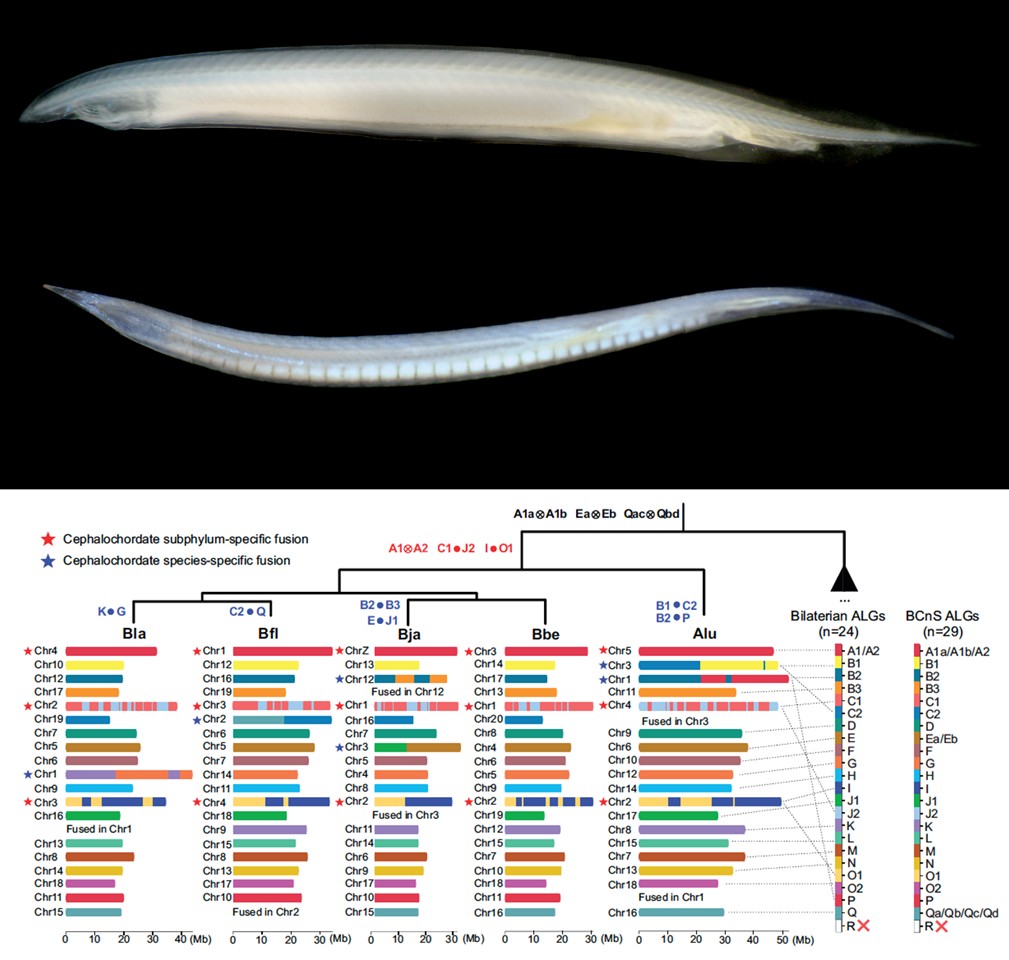
A chromosome-scale genome assembly for Asymmetron lucayanum helps to reconstruct the history of cephalochordate karyotype evolution.