
HDAC Sets the Speed Limit to Prevent DNA Replication and Transcription Machines from Colliding
- Date:
HDAC Sets the Speed Limit to Prevent DNA Replication and Transcription Machines from Colliding
Author: Shin Yen Chong, Ya-Ling Chen, Yueh-Tzu Hsu, Chia-Ling Hsu, Tsai-Ming Lu, Yi-Chen Lo, Cheng-Fu Kao.
Journal: Science Advances
LINK: https://www.science.org/doi/10.1126/sciadv.adz7842
Before cell division, cells must faithfully replicate their DNA to ensure the accurate transmission of genetic information to daughter cells. However, many genes remain actively transcribed during DNA replication. When the DNA replication machinery encounters the transcription machinery on the same genomic region, transcription–replication conflicts (TRCs) can arise, leading to replication fork stalling, DNA damage, and genome instability. Understanding how cells maintain efficient DNA replication through highly transcribed regions therefore remains a fundamental question in genome stability research.
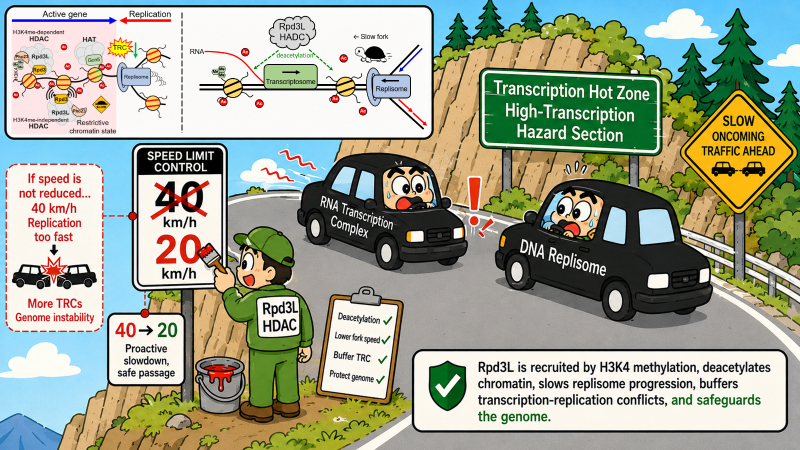
A recent study led by Research Fellow Cheng-Fu Kao at the Institute of Cellular and Organismic Biology, Academia Sinica, has uncovered how the Rpd3L chromatin deacetylase complex helps cells manage transcription–replication conflicts. The researchers found that Rpd3L can be recruited to chromatin through both H3K4 methylation-dependent and H3K4 methylation-independent mechanisms, where it regulates histone acetylation states and chromatin organization. This regulation influences the progression of DNA replication forks through actively transcribed regions, allowing replication forks to traverse conflict-prone genomic loci more stably and thereby reducing transcription-associated genome instability.
The study further revealed that disruption of either H3K4 methylation or Rpd3L function leads to elevated histone acetylation, accelerated replication fork progression through transcribed regions, and increased transcription-associated genome instability. In contrast, maintaining an appropriate balance of histone acetylation across multiple histone residues plays a critical role in preserving replication fork stability under replication stress. These findings suggest that Rpd3L functions not only in responding to DNA damage after it occurs, but also proactively regulates chromatin states and replication dynamics to minimize conflicts between DNA replication and transcription.
This work builds upon the team's previous study published in Nature Communications, which demonstrated that H3K4 methylation at active genes helps buffer transcription–replication conflicts during replication stress. The current study further elucidates how Rpd3L mechanistically links H3K4 methylation, histone acetylation, and replication fork dynamics, providing important new insights into how chromatin modifications coordinate genome stability maintenance.