
Ocean acidification disrupts squid brains, not eyes.
- Date:
Neurometabolic Rewiring in Squid (Sepioteuthis lessoniana) Optic Lobes Drives Behavioral Plasticity and Visual Integration under Environmental Acidification
As the ocean pH continues to decrease and greenhouse gases accumulate, the brains of apex predators are being discreetly reshaped. Dr. Yung-Che Tseng and his team at the Marine Research Station, studied how future ocean acidification will affect the brain function of the bigfin reef squid (Sepioteuthis lessoniana), a common predator in the western Pacific waters around Taiwan, by the year 2100. Their research indicates that predatory willingness is significantly reduced and the time required to capture prey is extended by up to 2.5-fold as a result of protracted exposure to seawater at pH 7.8. It is noteworthy that the Marine Research Station's electroretinogram (ERG) recordings have verified that the fundamental visual function remains unaffected by these circumstances. As a result, the team determined that the observed behavioral deficits are not due to sensory failure but rather to disruptions of higher-order neural integration circuits.
At the molecular level, the long-term increase in acidity in the optic lobes caused a big drop in different types of nicotinic acetylcholine receptor subunits, as well as problems with energy production and mitochondria. These findings suggest that metabolic constraint is the primary cause of behavioral impairment. The research questions the common belief about GABA and shows that squid exposed to long-term acidification elicit a wide-ranging response that involves building ribonucleoprotein complexes, maintaining Golgi apparatus function, and transporting vesicles. The collective results of these studies indicate that squid, which are frequently referred to as the primates of the sea, have an extraordinary ability to adapt to sustained environmental duress through multi-tiered neural adaptation.
The study was published in Communications Biology (2026, 9: 229). It was co-led by Prof. Garett J. P. Allen, a former postdoctoral fellow at Academia Sinica now based at Acadia University, Canada, and was carried out in collaboration with the Faculty of Fisheries at Kagoshima University, the High Throughput Genomics Core at the Biodiversity Research Center of Academia Sinica, the Imaging Core Facility at National Taiwan University College of Medicine, and the Department of Aquaculture at National Taiwan Ocean University. The research was supported by the National Science and Technology Council, Taiwan (NSTC 112-2628-B-001-013-MY3).
Publication: Communications Biology, Jan 8, 2026 https://doi.org/10.1038/s42003-025-09506-6
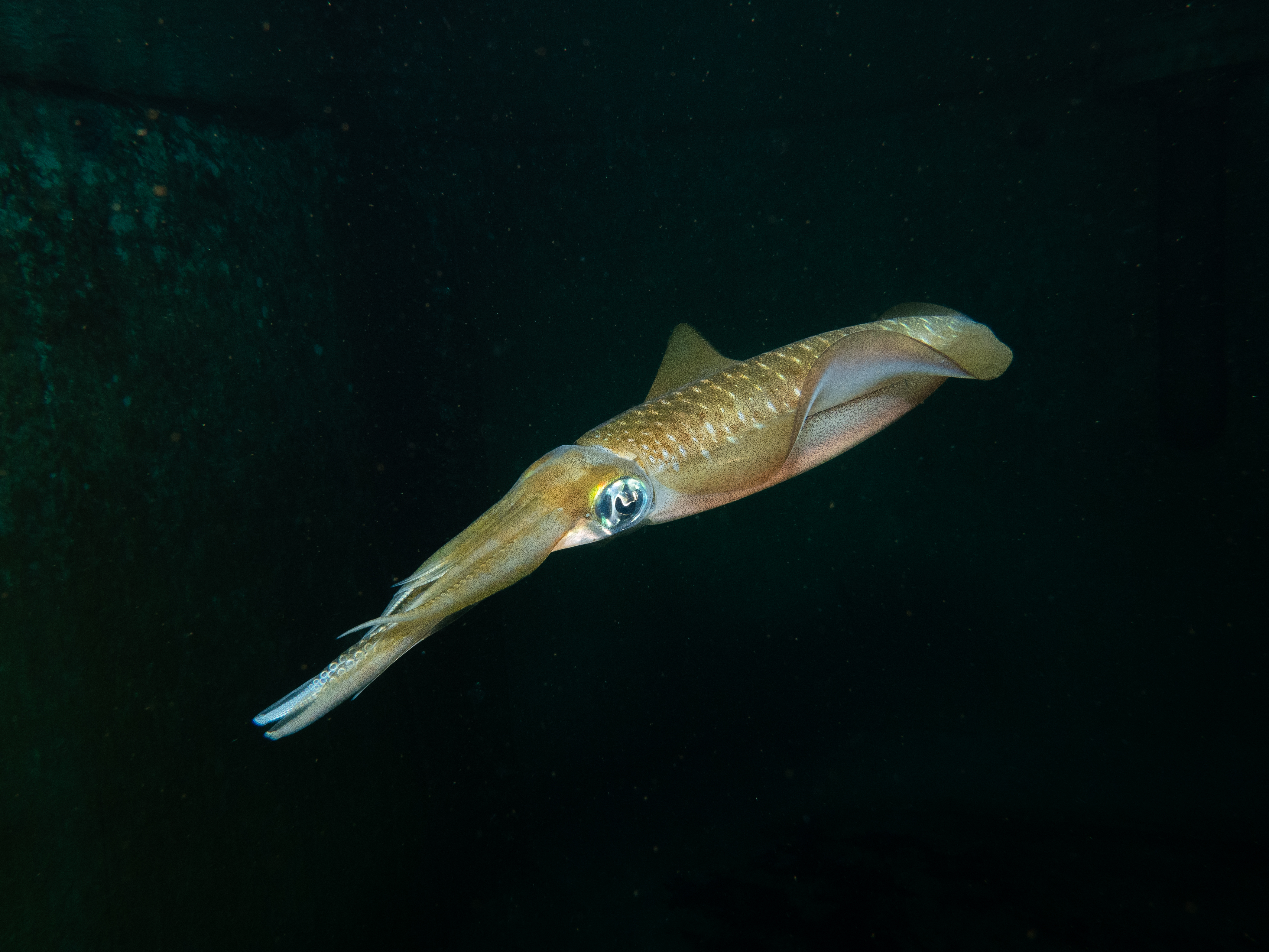
This study used Sepioteuthis lessoniana reared entirely in captivity at Marine Research Station, ICOB.