
Keeping the Energy Budget Right for Making an Egg
- Author:Oyundari Amartuvshin, Chi-Hung Lin, Yi-Ting Ke, Han-Jung Lee, Kreeti Kajal, Tsai-Ling Huang, Wen-Der Wang, Tsai-Ming Lu, Ling-Huei Yih, Chen-Yuan Tseng & Hwei-Jan Hsu
- Journal: Nature Communications https://www.nature.com/articles/s41467-025-65708-w
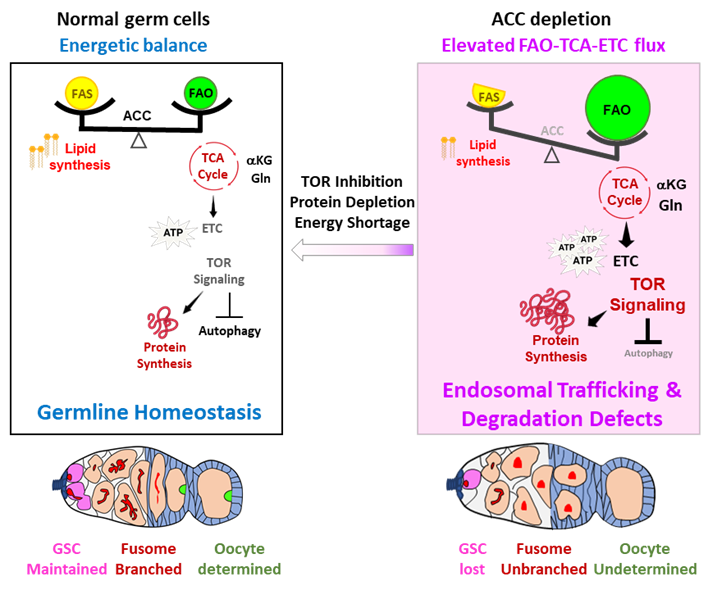
Acetyl-CoA carboxylase maintains energetic balance for functional oogenesis
Reproduction is tightly coupled to nutrient availability and metabolic homeostasis, yet how specific metabolic pathways interface with cellular signaling to regulate oogenesis remains unclear. Using a targeted RNAi screen in the Drosophila germline, we identify Acetyl-CoA Carboxylase (Acc), the rate-limiting enzyme in fatty acid synthesis, as an essential regulator of germline stem cell (GSC) maintenance and oocyte development. Loss of Acc shifts cellular metabolism toward fatty acid oxidation, increasing mitochondrial ATP production and hyperactivating TOR signaling. Elevated TOR activity drives excessive protein synthesis, leading to defects in endosomal trafficking and fusome branching, a germline-specific structure required for coordinated cyst divisions and oocyte specification. These phenotypes are rescued by inhibiting fatty acid oxidation, suppressing TOR signaling, reducing protein synthesis, or restricting dietary protein intake, indicating that Acc functions as a metabolic checkpoint maintaining germline homeostasis.
Importantly, this Acc–FAO–TOR axis is highly conserved, providing mechanistic insight into how metabolic imbalance can disrupt stem cell function. Our findings have translational relevance for understanding metabolic infertility and suggest that dietary or metabolic interventions may offer therapeutic avenues to preserve reproductive capacity in metabolic disease and aging.