
What Microbial World Lies Hidden in a Cuttlefish’s Renal Sac?
- Author:Ling Chiu, Shih-Han Wen, Pou-Long Kuan ,Yung-Che Tseng and Tsai-Ming Lu
- Journal: Frontiers in Microbiology https://www.frontiersin.org/journals/microbiology/articles/10.3389/fmicb.2026.1994344/full
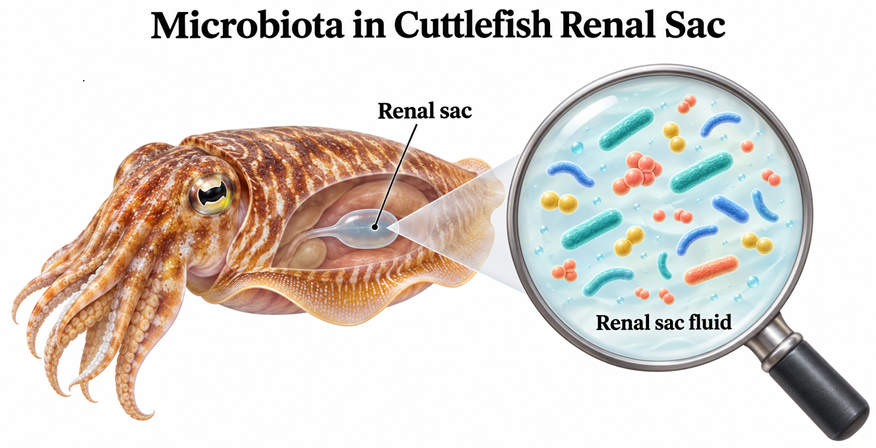
When you think about the relationship between animals and bacteria, gut microbes may come to mind first. But inside a cuttlefish, another intriguing habitat awaits exploration: the renal sac. Its fluid is acidic and contains high concentrations of nitrogenous waste, along with various organic compounds. Which bacteria inhabit this chemical environment, and what might they be capable of doing?
We studied the cuttlefish Sepia pharaonis, comparing renal sac fluid from laboratory-reared and wild-caught individuals. By sequencing bacterial 16S rRNA genes, we compiled a “membership list” of these microbial communities. We found that each individual harbored a distinct bacterial community. Wild-caught cuttlefish showed particularly striking individual differences, with no single bacterial group consistently dominating all samples.
Interestingly, although the members differed, their predicted functions were relatively similar! Using bioinformatics tools, we found that these communities may possess metabolic capabilities related to tryptophan and nitrogen. Think of different teams: even with different members, they may share similar skills.
These findings raise an intriguing question: could the renal sac’s distinctive environment act as a filter, favoring bacteria with similar metabolic potential? Our analyses offer some initial clues.