
EpCAM activates the ERK-EGR1 signaling axis and promotes TNF-α-induced the progression of anaplastic thyroid cancer
- Author:Authors:Chi-Chiu Lee, Yi-Jen Su, Sushree Shankar Panda, Chiung-Yi Chiu, Chung-Hsuan Wu, Tsai-Ming Lu, Pi-Chun Li, Yen-Lin Huang, Ruey-Long Hong, Shao-Hsi Hung, Cassian Yee, Stephen Y. Lai, and Han-Chung Wu
- Journal: Journal of Translational Medicine https://link.springer.com/article/10.1186/s12967-025-07575-z
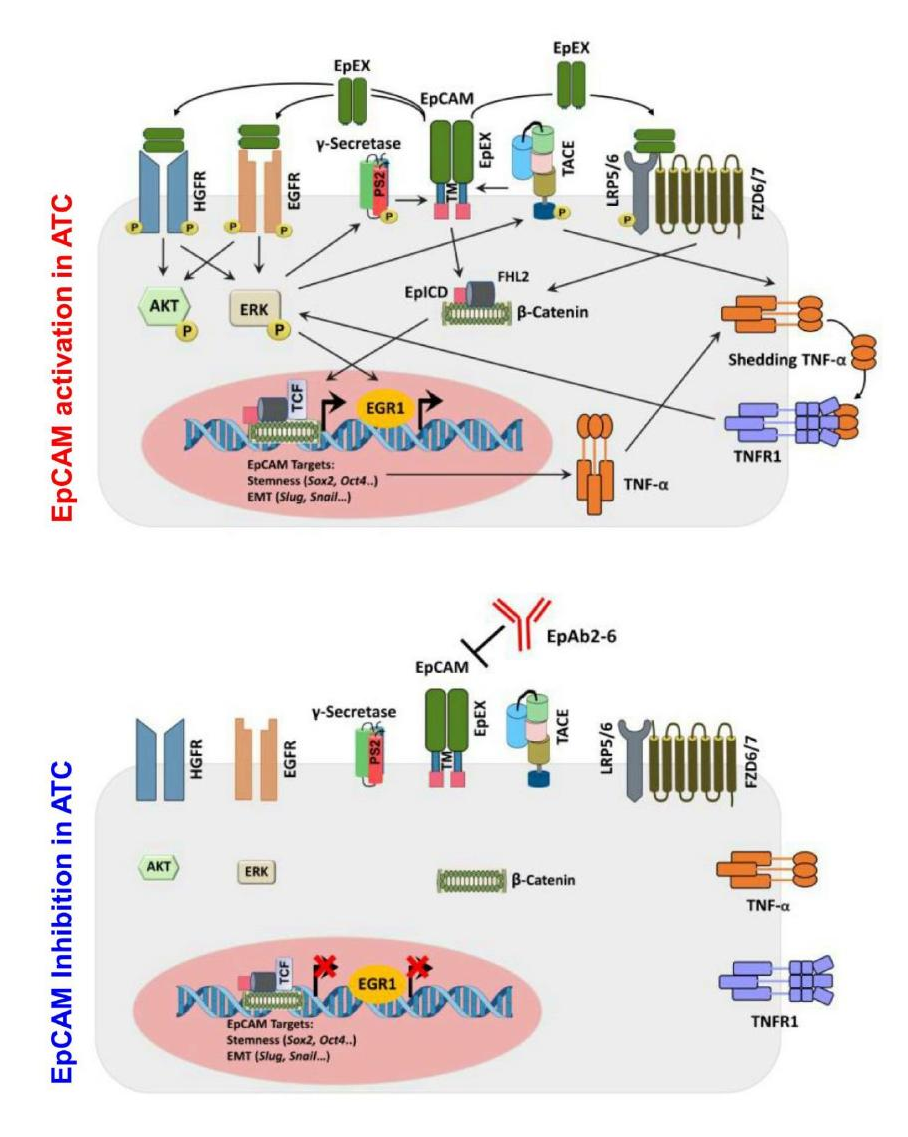
Epithelial cell adhesion molecule (EpCAM) is a pleotropic transmembrane glycoprotein comprising an extracellular domain (EpEX), a single transmembrane domain, and an intracellular domain (EpICD). For several types of cancer, high EpCAM expression is associated with tumor progression, metastasis, immune evasion, and overall poor prognosis. A rare but aggressive form of thyroid cancer, anaplastic thyroid cancer (ATC), has a mean survival time of only 3-6 months after diagnosis. Recently, a study by Dr. Han-Chung Wu’s group at the Institute of Cellular and Organismic Biology, Academia Sinica, has greatly advanced our knowledge of how EpCAM-mediated cell signaling can promote ATC cancer progression. In addition, the study introduces a new therapeutic combination strategy for treating ATC.
Dr. Wu’s group showed that the ATC cells typically exhibited a marked loss of membrane EpEX along with increased nuclear and cytoplasm accumulation of EpICD, as compared to non-ATC samples. Furthermore, we found that EpEX induced phosphorylation of EGFR, HGFR and Wnt receptors in ATC cells to promote cell growth, invasion and stemness activity. EpCAM signaling also increases TNF-α expression and induces TNF-α cleavage, and clarify the crosstalk between EpCAM and TNF-α to regulate ERK-EGR1 axis signaling. The inhibition of EpCAM signaling suppressed regulated intramembrane proteolysis (RIP) of EpCAM and shedding of the EpEX and EpICD in ATC cells. Combined treatment of EpAb2-6 and BRAF inhibitor dabrafenib coordinately induced apoptosis, while also inhibiting invasion, stemness and lung metastasis, and prolong survival in an animal model of metastatic ATC.
This study uncovers the molecular mechanisms underlying the promotion of anaplastic thyroid cancer (ATC) tumor progression by EpCAM signaling via the ERK-EGR1-TNF-α axis. Our findings suggest that the EpCAM neutralizing antibody may improve the therapeutic efficacy of the BRAF inhibitor, dabrafenib, in ATC. The study was published in the Journal of Translational Medicine, with Dr. Chi-Chiu Lee as the lead author.