
Insights into cephalochordate genome and gene evolution from the early-diverging amphioxus Asymmetron lucayanum
- Author:Yifan Ren, Zepu Miao, Che-Yi Lin, Ludong Yang, Huihui Li, Linda Z. Holland*, Sung-Jin Cho*, Jr-Kai Yu*, and Jia-Xing Yue*
- Journal: Proc. Natl. Acad. Sci. U.S.A. (2026) 123 (12) e2521280123 https://www.pnas.org/doi/10.1073/pnas.2521280123
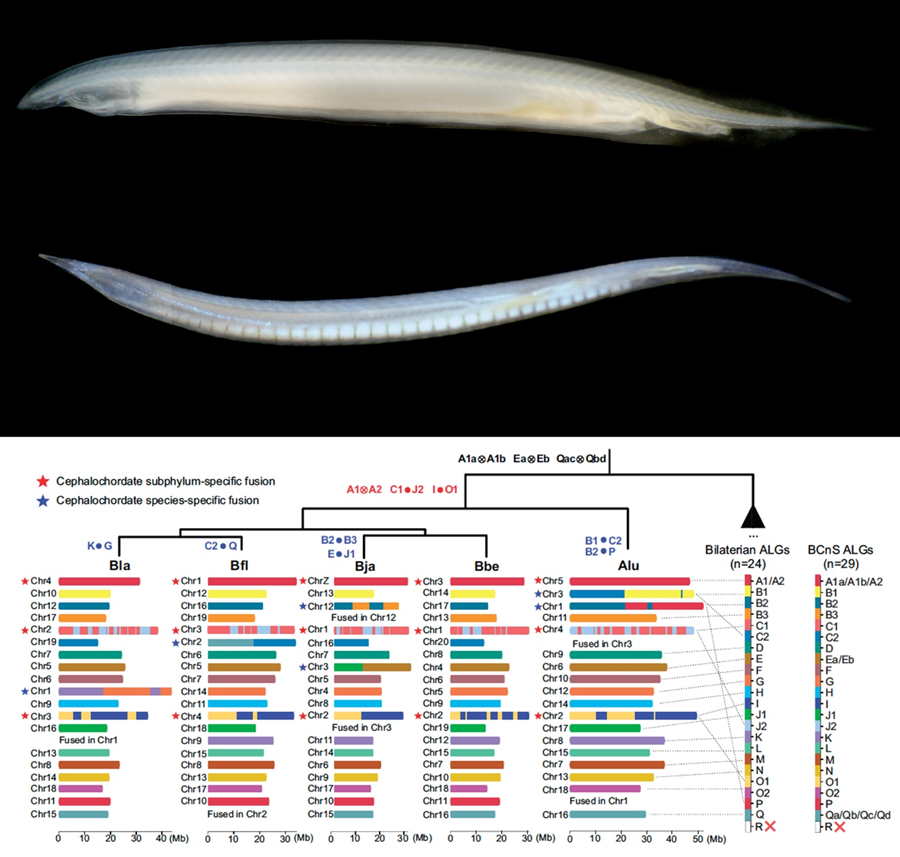
Cephalochordates (amphioxus or lancelet) are considered as living proxies for ancestral chordates due to their key phylogenetic position and slow evolutionary rate. The genomes of living amphioxus thus can help to reveal the genetic basis shaping the evolutionary transition from nonvertebrate animals to vertebrates. To gain a comprehensive understanding of the genome architecture in amphioxus, we generated a chromosome-anchored genome assembly for Asymmetron lucayanum, representing the earliest diverging cephalochordate genus. We show that Asymmetron has an enlarged genome compared to those of the other four cephalochordate genomes decoded so far (all in the genus Branchiostoma), caused by pervasive expansions of intergenic transposable elements (TEs). Nevertheless, both macrosynteny and microsynteny remain highly conserved between Asymmetron and Branchiostoma, enabling reconstruction of the ancestral genomic architecture of the cephalochordate lineage for tracing genome evolutionary processes during deuterostome and chordate diversification. Integration of developmental transcriptomic data further reveals that selective constraints on cotranscriptional regulation underline the maintenance of the conserved microsynteny blocks among cephalochordate species. We also examine the evolutionary history of the Hox cluster in cephalochordates and vertebrates, and identify species-specific inversions and TE invasions at this locus in both Asymmetron and Branchiostoma. Finally, we survey key molecular building blocks underlying both innate and adaptive immunity (e.g., TLR, NLR, MHC, and RAG) and uncover their evolutionary dynamics and plausible ancestry in chordates. Taken together, our findings illuminate the genome and gene evolution of cephalochordates and provide valuable resources for understanding the early evolution of chordates and the origin of vertebrates.