
Targeted RNA Silencing Rescues Neurodevelopmental Deficits in Mice
- Author:Chih-Ming Chen*, Yu-Min Huang*, Chih-Ching Chung, Richard C. Johnson, Cheng-Ya Tsai, Yu-Han Chen, Han L. Tan, Fu-Yun Hsiao, Richard L. Huganir#, Shu-Ling Chiu#
- Journal: Neuron (2026; published online November 11, ahead of print) https://www.sciencedirect.com/science/article/pii/S0896627326008093?via%3Dihub
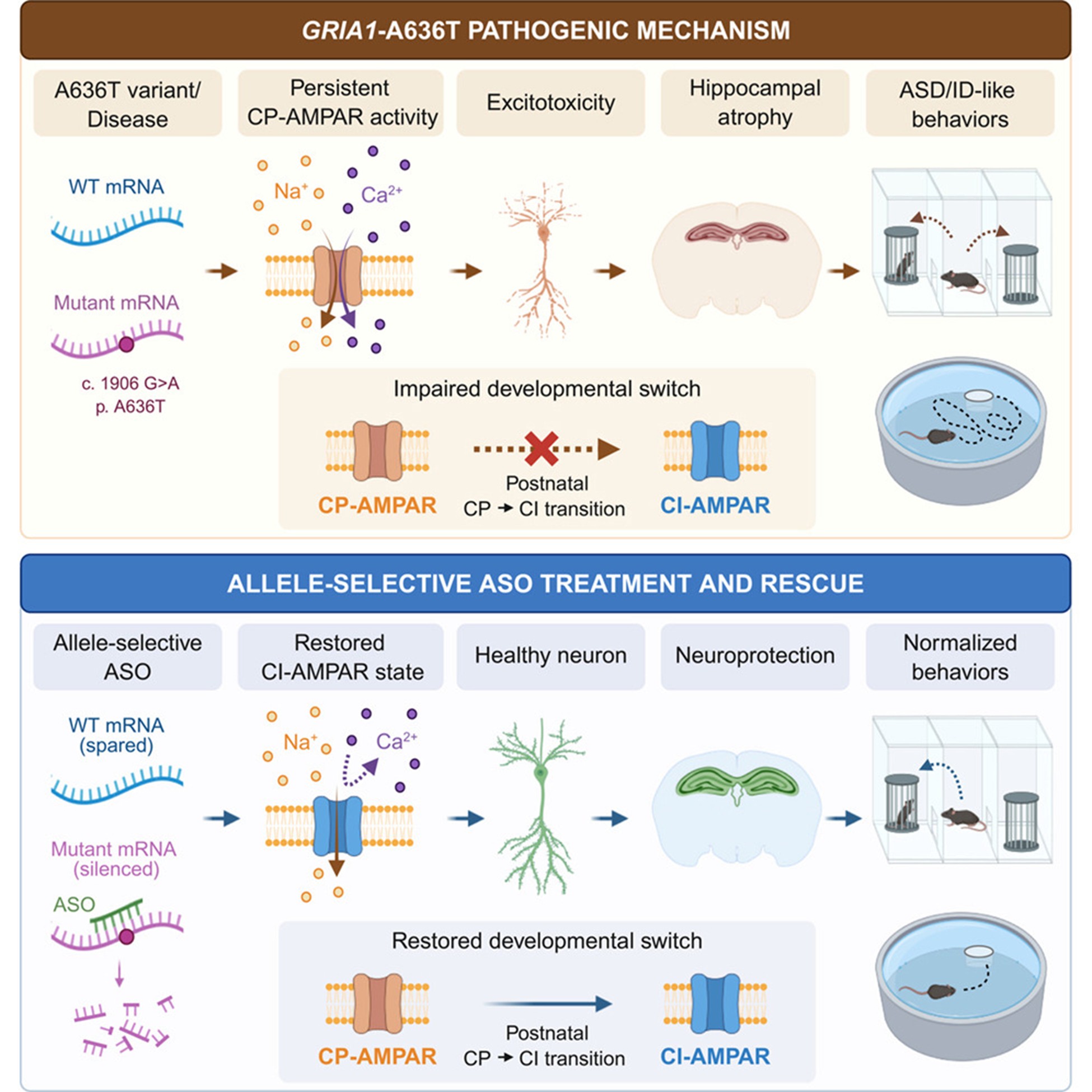
How can a single genetic mutation disrupt brain development, and can its harmful effects be prevented? A recent study published in the journal Neuron investigated a recurrent GRIA1 variant (A636T) that was identified in individuals with autism spectrum disorder (ASD) and intellectual disability (ID).
AMPA receptors mediate excitatory communication between neurons, while the activity of calcium-permeable AMPA receptors normally declines during brain development. Using genetically engineered mice, researchers discovered that the A636T mutation alters the gating properties of AMPA receptor channels, enhancing excitatory signaling and disrupting the normal developmental regulation of calcium permeability. This leads to excessive calcium entry, neuronal death, and neuroinflammation, resulting in progressive degeneration of the hippocampus, an essential brain region for learning and memory, and are accompanied by impaired social and cognitive behaviors.
To target the underlying cause, the team developed an allele-selective antisense oligonucleotide (ASO), a short synthetic molecule that selectively suppresses the mutant GRIA1 RNA while preserving the normal copy. A single treatment shortly after birth prevented neuronal damage, and improvements in social interactions, learning, and memory extended into adulthood.
These findings reveal how abnormal AMPA receptor function causes neurodevelopmental disorders and provide proof-of-concept evidence for RNA-based precision therapies. Further studies are needed before clinical application, but this work opens a promising avenue for treating genetically defined neurodevelopmental disorders.
The study was led by Dr. Shu-Ling Chiu's laboratory at Academia Sinica, in collaboration with Dr. Chih-Ming Chen's group at Chang Gung University, and Prof. Richard L. Huganir's laboratory at Johns Hopkins University.